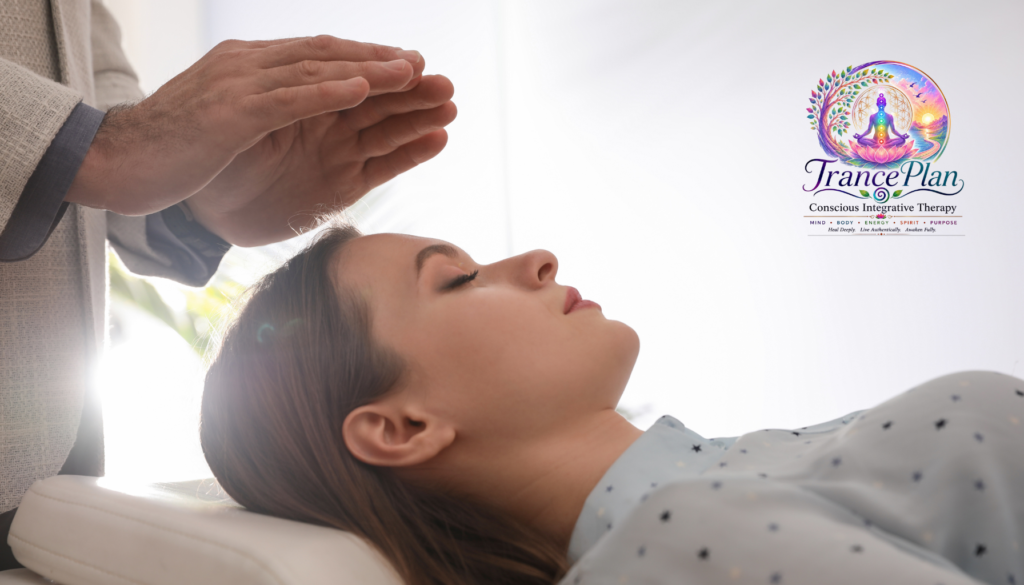

A preview of “Mindset,” a 45-minute module from the TrancePlan course Susan is developing. Educational only. Not continuing education, certification, or clinical treatment, and not a qualification to practice CIT.
First, do no harm
“First, do no harm” should go without saying. Even if you are not a licensed mental health professional, you still need a strong ethical base to practice. At any stage, you can apply some of the principles that Conscious Integrative Therapy (CIT) uses. The first two Yamas, Ahimsa (non-harming) and Satya (truthfulness), apply very directly to this work.
Ahimsa: non-harming in practice
Ahimsa starts with knowing when hypnotherapy may not be appropriate, or may need a licensed clinician involved. Use caution or screen for, and refer out when needed:
- Active or recent psychosis, including schizophrenia-spectrum conditions
- Recent or unprocessed trauma
- Uncontrolled bipolar disorder
- Active suicidal or homicidal ideation
At intake, the consent form should always include a clear caution and emergency numbers, such as 988 (Suicide & Crisis Lifeline) and 911.
Your website and any other materials should also carry cautions and disclaimers. If you are not licensed where you practice, say clearly that you cannot diagnose or treat mental health conditions. The same applies when you teach.
Ahimsa also has an inner side. If you understand non-harming as being at peace within yourself, it fits any spiritual or religious path.
Satya: truthfulness and trust
The second principle is Satya, or truthfulness. Clients often value honesty from their provider a great deal. Clients have to place a lot of trust in a provider, so the work should help them build that trust over time.
Many clients don’t know much about hypnotherapy or CIT and will have questions, so answer them openly. Meet the client where they are and begin. Taking small steps, a core idea in CBT, works well, especially once the client feels comfortable enough to be a little vulnerable.
Alignment between client and provider
Hypnotherapy goes better for both people when what the client wants matches what the provider will say during the session. To build that alignment, pay attention to:
- How the client makes eye contact
- How they breathe and how they sit
- How they speak, including accent and tone
- What they tell you, and what they leave out
Alignment is not a new idea. Many Indigenous cultures have long understood how to be in alignment with another person.
Preparation: breath and sound
Before the first session, I often suggest a three-minute alternate nostril breathing exercise. I also send sound links: 432 Hz, 528 Hz, brown noise, and nature sounds. Many people find these sounds calming, although the specific claims sometimes made about particular frequencies have not been established. I ask the client to do the breathing with the sound and tell me how it went. If they enjoy it, that suggests they are open to working with their energy.
Ask first whether the client has any trouble breathing. A deviated septum or heavy congestion can make the exercise hard. The question can also show whether someone mostly breathes through the mouth. Habitual mouth breathing is worth noticing; usually not in the first session, I may suggest the client read about it or raise it with their physician. Even so, the breathing exercise can still help.
With a deviated septum, go very slowly and never force the breath. Practiced daily, alternate nostril breathing is a simple practice that many people find calming. Some studies have explored its effects on blood pressure and heart rate, but the results vary, so treat these as possibilities rather than established effects. Some clients tell me they notice changes in their own readings; I treat that as a hypothesis worth exploring, not established physiology.
As I tell clients:
“If attending to your breath reliably makes things worse, that is information, not failure. Use something external instead — feet on the floor, sound, sight, temperature, movement — and raise it with a professional who knows your history.”
Why breathwork prepares for hypnotherapy
Breathwork with sound prepares a person for hypnotherapy because the induction itself starts with simply noticing the breath. Noticing the breath turns attention inward, away from whatever the person was just thinking or saying.
As the person keeps focusing on the breath, I typically see a shift. Their thoughts become fewer, their body settles, and their heart rate slows. This is especially true lying down, flat and parallel to the earth. That posture resembles Savasana (corpse pose, or final resting pose) in yoga, which is also the posture used for Yoga Nidra.
In the yogic traditions of Hinduism and in Ayurveda, Yoga Nidra is described as purifying the energy channels (nadis) and chakras. Personally, I find it a profound practice. Modern science also recognizes that brain-wave patterns change across the day and night. Both Western and Eastern approaches aim for balance and alignment, so a person can maintain their own health and well-being. Many practitioners, including many providers, now use adapted practices that come from Ayurveda and yoga, and all of these deserve respect.
A note on spiritual language
Abrahamic religions have shaped much of the world for thousands of years. Because of this, people often describe a spiritual or religious experience as coming from a God outside themselves, in a realm called heaven. Hinduism, Ayurveda, and Buddhism can accept this view as a cultural interpretation. CIT meets clients within whatever framework they bring.
The first stage: safety in the body
The first step of the induction, noticing the breath, leads into the second step: noticing the pulse and flow of fluids in the body, especially in the hands and feet. This helps the person find a comfort zone within themselves that takes no effort or thinking. It starts to build inner awareness, so they feel safer in their own body as they go through each step.
The goal of this first stage is balance and alignment, so the person can simply feel safe inside their own body. Loops of suggestion are woven into the work with every energy channel and chakra.